Why does a vegan strawberry rhubarb galette stay crisp?
The best vegan strawberry and rhubarb galette has a crisp, flaky rim, a soft fruit centre, and no puddle of juice under the pastry. The trick is not a fancy ingredient. It is controlling water at every stage.
The free-form shape solves the main pie problem
A galette bakes on a flat sheet instead of inside a deep pie dish. That gives steam an easy escape route. The shallow filling also cooks faster, so the strawberries soften without turning the whole crust into paste. Leave a 5-centimeter border around the dough and fold it over the fruit in loose pleats. Tight folds trap juice. Loose folds let the pastry expand.
Keep the dough cold. Vegan butter melts faster than dairy butter, especially in a warm kitchen. Chill the rolled dough for 20 minutes before adding the fruit. If the dough feels soft or greasy, chill it again. Do not try to rescue warm pastry with extra flour. That makes the crust tough.
Rhubarb brings sharpness, strawberries bring water
Rhubarb has a firm, fibrous texture and a clean sour taste. Strawberries are much wetter and collapse quickly in the oven. Use roughly equal weights, but cut the rhubarb into 1-centimeter pieces and slice large strawberries into quarters. Small berries can stay halved.
The filling needs sugar for balance, cornstarch for structure, and lemon juice only in a small amount. The fruit should look glossy, not swim in liquid. That is the visual test that matters.
How much sugar and starch does the filling need?
Use 300 grams of strawberries and 300 grams of rhubarb for one 25-centimeter galette. This amount gives you a generous fruit layer without burying the pastry. More fruit sounds generous, but it produces a wet centre and a collapsed edge.
The reliable filling ratio
| Ingredient | Amount | Job | What to change |
|---|---|---|---|
| Strawberries | 300 g | Sweetness, colour, soft texture | Drain very juicy berries after slicing |
| Rhubarb | 300 g | Sourness and structure | Use 350 g for a sharper filling |
| Granulated sugar | 100 g | Balances rhubarb and draws out juice | Reduce to 80 g only with very sweet berries |
| Cornstarch | 24 g | Thickens fruit juices | Use 30 g if the berries are exceptionally wet |
| Lemon juice | 10 g | Adds brightness | Do not exceed 15 g or the filling gets loose |
Mix the filling at the last possible moment
Whisk the sugar, cornstarch, and a pinch of salt in a bowl first. Add the fruit, lemon juice, and one teaspoon of vanilla only when the pastry is ready. Toss gently and transfer the filling immediately. If the fruit sits for 30 minutes, it releases juice before baking, and the starch cannot catch up.
Do not cook the filling on the stove first. That method works for jam, but it makes this galette filling too soft and removes the fresh shape of the fruit. The oven should do the cooking.
How do you make vegan galette dough from scratch?
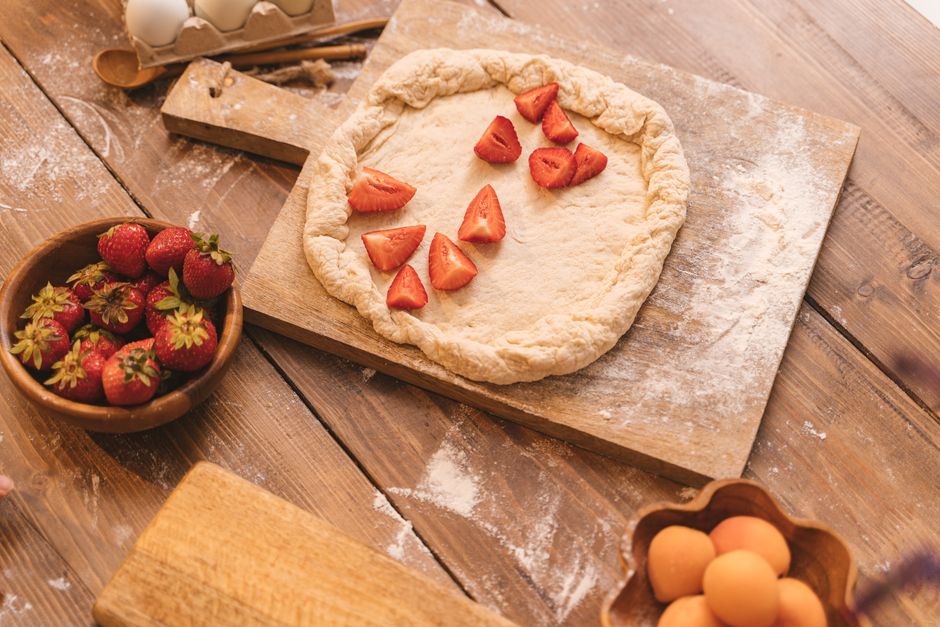
Make the pastry with 180 grams plain flour, 25 grams caster sugar, half a teaspoon of fine salt, 113 grams cold vegan butter, and 60 to 75 grams ice water. Add one teaspoon of apple cider vinegar to the water. It helps the dough stay tender, but the cold liquid matters more than the vinegar.
Build the dough without warming it
- Whisk the flour, sugar, and salt in a wide bowl.
- Cut the cold vegan butter into small cubes and rub it into the flour until you have flat flakes and pea-sized pieces. Leave some larger pieces. They create flaky layers.
- Drizzle in 60 grams of ice water and toss with a fork. Add the remaining water one teaspoon at a time only if dry flour remains.
- Press the dough together with your hands. Do not knead it. A rough, slightly cracked ball is correct.
- Flatten the dough into a disk, wrap it, and chill it for at least 45 minutes.
Roll by measurement, not guesswork
Roll the dough into a circle about 30 centimeters wide and 3 millimeters thick. A digital scale such as the Escali Primo, which handles up to 5 kilograms, makes the flour and butter ratios repeatable. That matters because a dough with 15 extra grams of water can bake noticeably softer.
Roll from the centre outward and turn the dough often. Patch cracks with a damp fingertip. Do not add a thick border to hide damage. The border will bake unevenly and stay doughy underneath. Chill the rolled circle on parchment for 20 minutes before filling it.
How should you assemble and bake the galette?
My rule is simple: cold pastry, dry-looking filling, very hot oven. Miss any one of those and the galette loses its edge. Heat the oven to 200°C (180°C fan) with a rack in the lower-middle position. A hot oven sets the vegan butter before the fruit can soak through the base.
Fold the edge without sealing in steam
Place the chilled pastry on parchment. Spoon the fruit into the centre, leaving a 5-centimeter border. If the bowl contains a pool of liquid, leave most of it behind. Fold the border over the fruit in six to eight loose sections. Press only where the folds overlap.
Brush the pastry with plant milk mixed with a teaspoon of maple syrup. Sprinkle the edge with coarse sugar. Make two or three small openings in the top fruit layer. These openings let steam escape without splitting the crust.
Bake until the underside has colour
Use a large rimmed baking tray. A silicone baking mat also works, but parchment gives the bottom slightly better browning. Bake for 40 to 50 minutes, rotating once after 25 minutes.
The galette is done when the pastry is deep golden at the folds and the fruit bubbles in the centre. The filling will look loose when hot. Let it cool for at least 45 minutes. The cornstarch finishes setting as the juices cool. Cutting early is the fastest way to create a runny slice.
Why is my vegan galette soggy or leaking?
Most failures come from timing, not from the recipe. The fruit is mixed too early, the dough is warm, or the galette comes out before the base has browned. Fix the cause instead of adding random flour.
Why did the bottom turn soft?
If the top is brown but the bottom is pale, the tray was probably too high in the oven or the pastry was too thick. Bake on the lower-middle rack and roll the dough to about 3 millimeters. A dark metal tray also browns the base faster than a pale ceramic surface.
A wet filling can soften a good crust after baking. Drain excess juice from the bowl before transferring the fruit. Do not dust the pastry with a thick layer of flour. If you need extra insurance, scatter one tablespoon of ground almonds or fine breadcrumbs under the fruit. They absorb juice without making the filling taste starchy.
Why did the crust crack or spread?
Cracks usually mean the dough lacks water or became too cold to roll. Let it sit for five minutes, then patch it with your fingers. Spreading means the vegan butter warmed before baking. Chill the assembled galette for 15 minutes and check that the oven has reached 200°C.
Do not use frozen fruit for this version. It releases too much water and turns the centre into sauce before the pastry sets. Fresh or well-drained thawed fruit works better, but fresh strawberries and firm rhubarb give the cleanest slices.